
National Energy Transition Roadmap (NETR) Commercialization Guide
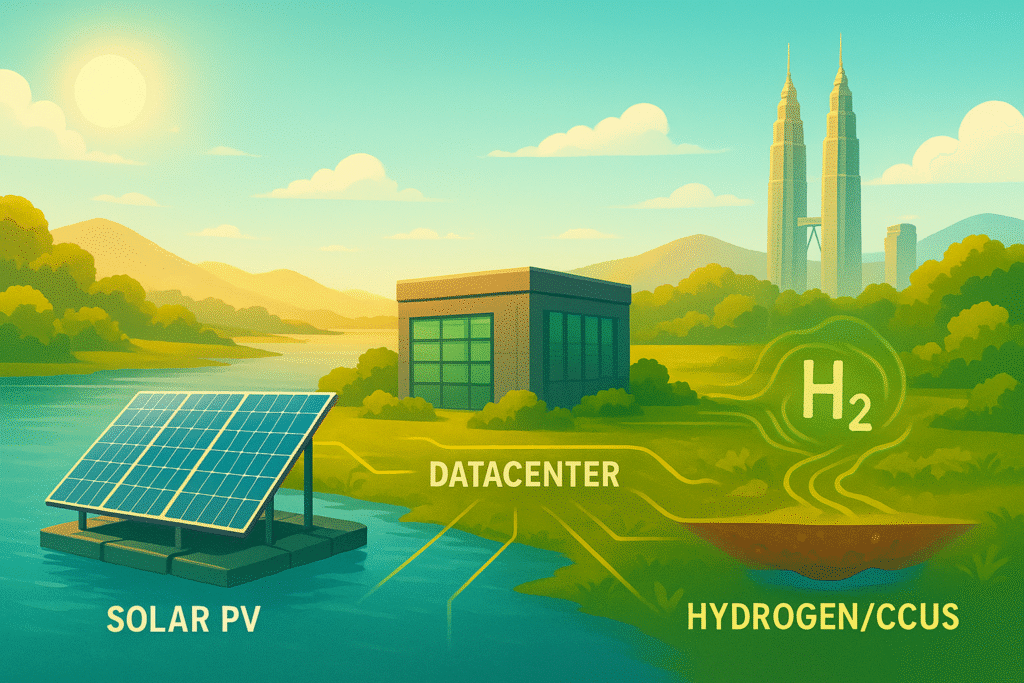
The intersection of the National Energy Transition Roadmap (NETR) levers: Solar PV, Data Centers (Digitalization), and Hydrogen/CCUS.
This guide was developed in response to repeated questions from engineering and commercial teams navigating Malaysia’s National Energy Transition Roadmap (NETR).
Rather than restating policy documents, this guide focuses on commercialisation challenges, execution bottlenecks, and technical-finance coordination gaps observed at project planning stage.
Common Failure Points Observed at FEED Stage
* Grid compliance assumptions made before TNB engagement. * Financing criteria are misaligned with the technical configuration * M&E scope fragmentation across consultants * Late discovery of interconnection or permitting constraints
Introduction: Energising the Nation, Powering Our Future
The National Energy Transition Roadmap (NETR) provides a framework for Malaysia’s journey toward a low-carbon, high-value economy. It identifies technological clusters critical for decarbonization, investment, and job creation. This guide synthesizes the key commercialization strategies, regulatory mandates, and technological solutions underpinning the primary energy transition clusters.
Renewable Energy (RE) Acceleration - Solar PV Focus with BESS
Focus: Accelerating Solar Adoption and BESS Integration
The strategy to maximize our solar potential relies on optimizing two key technological fronts. For large-scale utility projects (LSS), the goal is reducing the Levelized Cost of Energy (LCOE) through advanced technologies like Bifacial Modules and Single-Axis Tracking.
Corporate Green Power Programme (CGPP)
Meanwhile, the Corporate Green Power Programme (CGPP) drives the distributed market, where corporate off-takers (especially Data Centres) mandate the integration of Battery Storage to manage intermittency and meet high-bar ESG goals. The stability of Floating PV (FPV) further diversifies our deployment by utilizing reservoir surface area and mitigating land-use conflicts.
Bioenergy and Sustainable Fuels
Focus: Converting Waste Streams into Dispatchable Power
Bioenergy plays a dual role in the NETR: providing dispatchable power and generating high-value Sustainable Aviation Fuel (SAF). Domestic agricultural waste, primarily Palm Oil Mill Effluent (POME) for biogas and Empty Fruit Bunches (EFB) for biomass, forms the bedrock of this cluster. The primary challenge lies in handling feedstock logistics—like high moisture content—which necessitates solutions like mechanical drying.
Furthermore, Bioenergy holds Carbon Negative Potential when combined with Carbon Capture and Storage (Bio-CCS), representing a premium opportunity as international traceability standards for SAF (like CORSIA) mature.
Energy Efficiency (EE) and Data Centres
Focus: Driving Digitalization through Efficiency
Energy Efficiency mandates are the foundation of digital growth. The upcoming EECA (Energy Efficiency and Conservation Act) creates a mandated market for ESCOs through Energy Performance Contracts (EPCs) across commercial and industrial sectors.
For the energy-intensive Data Centres, this translates into critical focus areas like achieving a sub-1.4 PUE and rapidly adopting advanced cooling technologies, including Liquid Cooling (direct-to-chip).
This focus on efficiency, supported by AI/ML-enabled BMS and IE4/IE5 motors, is necessary for Malaysia to remain a competitive regional digital hub.
Hydrogen Infrastructure and Supply Chain
Focus: Establishing the Green Hydrogen Export Economy
The long-term strategy for Green Hydrogen involves scaled production via Gigawatt-scale Electrolyser Parks, primarily leveraging Sarawak’s ample hydropower.
For logistics and export viability, H₂ must be converted into a denser carrier like liquid ammonia (NH₃), which requires the design and deployment of advanced cryogenic handling and specialized export terminals.
Domestically, massive scale Underground Salt Caverns and geomechanical assessment are crucial to prevent risks like H₂ embrittlement in storage and transport infrastructure
Carbon Capture, Utilisation, and Storage (CCUS)
Focus: Decarbonization and Establishing the CO₂ Storage Hub CCUS
Decarbonization and establishing the CO₂ Storage Hub CCUS are the primary tools for decarbonizing hard-to-abate industries.
The commercial pathway relies on defining a new Legal and Regulatory Framework to manage the long-term liability of Geological Storage Hubs (depleted reservoirs).
Technical solutions, primarily Post-Combustion Capture (Amine Scrubbing) for large emitters, are made commercially viable through the development of Shared-Use CO₂ Pipelines (Hubs).
Crucially, Carbon Utilisation (CCU) offers revenue potential by converting captured CO₂ into high-value products, offsetting the capture cost.
Let us find YOU
Malaysia's Project Insights 2026/2027
Frequently Asked Questions (FAQs) on the NETR
The biggest, most immediate opportunity lies in Solar PV combined with Battery Energy Storage Systems (BESS). Regulatory frameworks like the Corporate Green Power Programme (CGPP) and LSS tenders are rapidly driving demand for scalable, reliable, clean energy solutions
is the direct decarbonization solution for heavy industries like cement and steel. By developing Malaysia as a regional CO₂ storage hub, the regulatory framework is creating immediate commercial opportunities for emitters and storage operators.
Dispatchable power—the ability to generate electricity on demand—is primarily secured through Bioenergy (using stable agricultural waste streams) and large-scale BESS infrastructure. These systems stabilize the grid and ensure power is available when solar output is low.
EE mandates, such as the Energy Efficiency and Conservation Act (EECA), create a guaranteed market for Energy Service Companies (ESCOs). This is critical for the growth of Data Centres, which need high-efficiency cooling technologies (like liquid cooling) and reliable, clean power to meet their regional growth targets.
The main long-term export focus is Green Hydrogen. Leveraging Sarawak’s large hydropower resources, the strategy is to establish gigawatt-scale electrolyser parks to produce competitive Green Hydrogen and convert it into exportable carriers like green ammonia
Related Technical Deep Dives
BESS Deep Dive for Investors & Developers
BESS for Revenue Stacking and Grid Stability in Malaysia’s Energy Transition
Data centres: Opportunities in Malaysia’s Green Digital Hub
Hyperscale Data centres for M&E consultants
Bioenergy Deep Dive: Securing Feedstock and Generating Dispatchable Power
Bioenergy and Waste-To-Energy for M&E consultants
CCUS & CO₂ Storage Hub Malaysia: Investment, Tax Incentives
Hydrogen Infrastructure and Supply Chain Opportunities in Malaysia
Solar LSS : The Financial Landscape of Commercial & Industrial in Malaysia.